COMPACtenna … COMPACT antenna
Easy to Install Easy to Use
VEHICLE & BASE STATION
7.5″ & 9″ VHF/UHF models
Models: 2M/440 2M/220/440 2M/440PLUS 220MAX LMR-I SCAN-III
Vehicle Application
Generally, best performance of a mobile antenna is achieved with location at the top of the vehicle.
Long antennas can be unsightly and often do not allow travel into garages, beneath underpasses,
and standard technology short antennas have significantly decreased performance and bandwidth.
COMPACtenna is LESS restrictive than most antennas which have only one optimum spot, being the center of the roof ONLY.
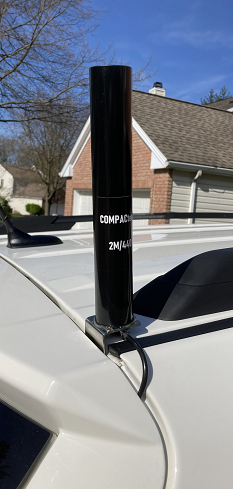
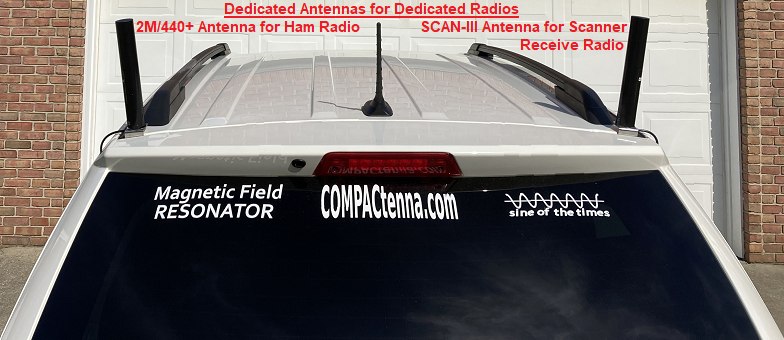
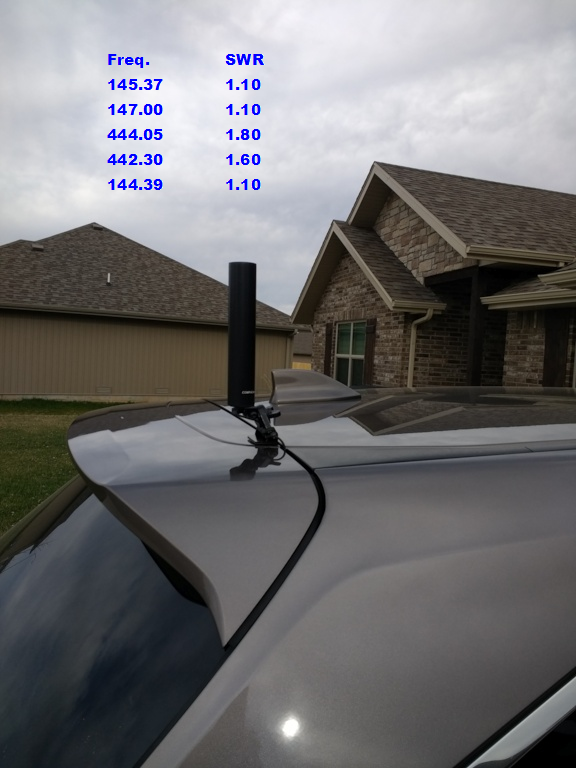
COMPACtenna 7.5″/9″ models have MULTIPLE optimum possible locations, the upper corners of the vehicle;
they are designed for best results (SWR, Performance) at an upper corner of a vehicle.
Tech.:
With a short antenna, the hot voltage point is quite close to the ground plane counterpoise with consequently low resistance.
The high inductance and capacitance of the COMPACtenna magnetic field resonator design
are balanced at the corners for proper overall impedance in a short antenna,
working in conjunction with the downward/sloping metal of the
vehicle at the corner locations having increased resistance effect.
And this geometric dimensional counterpoise also results in
a substantially omnidirectional VHF/UHF pattern.
METAL Ground Plane Vehicle Counterpoise
Apply antenna mount to metal with good (clean) ground connection
(magnet mount and often clamp types provide capacitive coupling to ground)
Vehicle Antenna Mount Types
Through-Hole mounts with vehicles with metal roofs have been found to work optimally more consistently than many other types.
One benefit is that they don’t have the challenge of adequate connection/coupling to ground plane counterpoise that some mount types may.
L-Bracket & Adjustable-Universal Bracket attached-to-vehicle-metal with screws type mounts are also favorites by many for similar reasons.
Magnet Mounts: As can be seen by the formulas, etc. below, magnet mount capacitive coupling is often quite good at VHF/UHF frequencies..
Lip Adjustable Mounts: See below.
If creating a hole/holes is/are being considered such as for a thru-hole mount or a bracket-with-screws type mount,
temporarily securing the mount, or trying a magnet mount (on steel, magnetically secured;
on aluminum, supported – capacitive coupling exists with both) or a clamp mount at/near the intended location,
with vehicle stationary and clear of surrounding metal, may help to give an idea of SWR before the hole(s) is/are made.
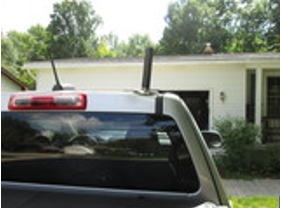
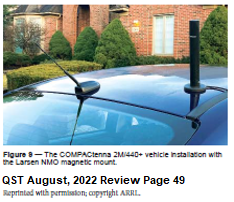
NMO Magnet Mount
Magnet mount on corner of pickup truck cab:
Magnet Mounts
Capacitive Coupling Reactance
A magnet mount provides good coupling,
particularly at VHF/UHF, with little capacitive impedance:
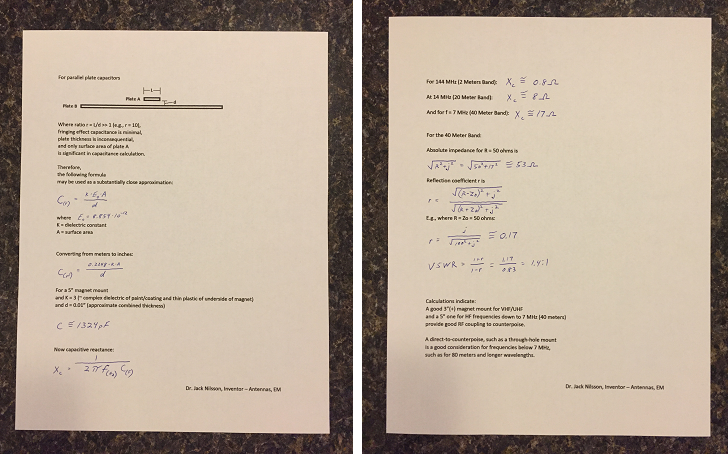
[Note that a magnet mount with a “thick” rubber bottom ‘boot’ will decrease capacitive coupling.]
For VHF/UHF, ‘flatter style’ magnet mounts often provide best SWR’s.
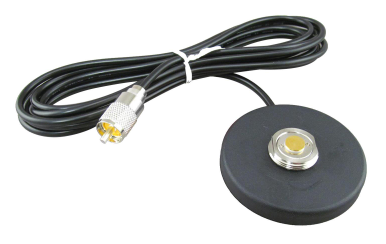
Examples of magnet mounts
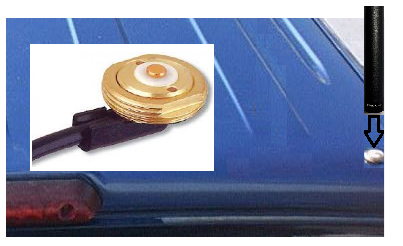
With these Pulse-Larsen magnet mount types, designed for up to microwave frequencies, leave the center pin/disk and inner dielectric in place:
NMO Magnet Mount at DX Engineering (solder type PL-259)
NMO Magnet Mount at Ham Radio Outlet (crimp type PL-259)
NMO Thru-Hole (Roof Type) Mount

Some NMO Thru-Hole Mounts require a 3/4″ hole, these require only a 3/8″ hole:
Diamond C213SNMO Mount at DX Engineering
Diamond C213SNMO Mount at Ham Radio Outlet
Hustler CHMA-P at Ham Radio Outlet
L-Bracket Body Mount Upper Corner Hatchback with NMO
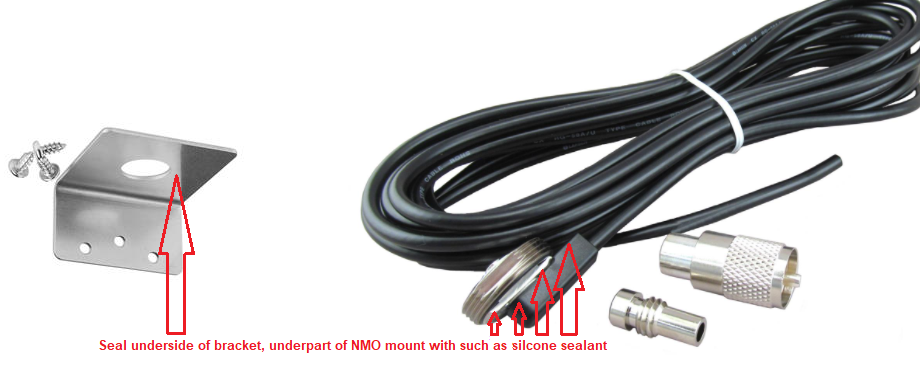

Example of NMO L-Bracket Mount Assembly
Larsen L-Bracket (3/4″ NMO hole) at DX Engineering
Larsen NMO Thru-Hole Mount with cable for 3/4″ hole at DX Engineering
Adjustable-Universal bracket mount option
Can provide greater clearance and flexibility to achieve upper corner hatchback vehicle antenna mounting as above:
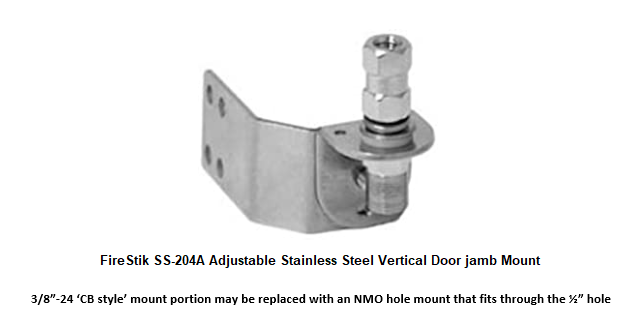
Below: A couple NMO through-hole mounts to consider for adjustable mount above
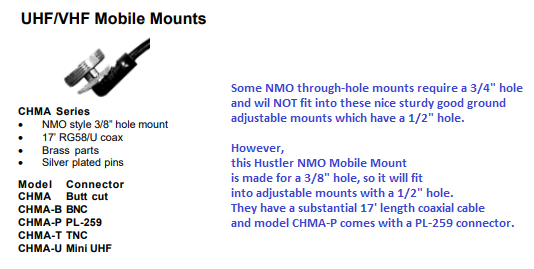
Hustler CHMA-P at Ham Radio Outlet
Many vehicles allow passage of small ~0.2″ diameter RG-58 coaxial cable as with the Hustler CHMA-P mount above,
but some vehicles have especially narrow gaps between the closed hatch/door.
The Diamond NMO mount below has 1/8″ diameter coaxial cable:
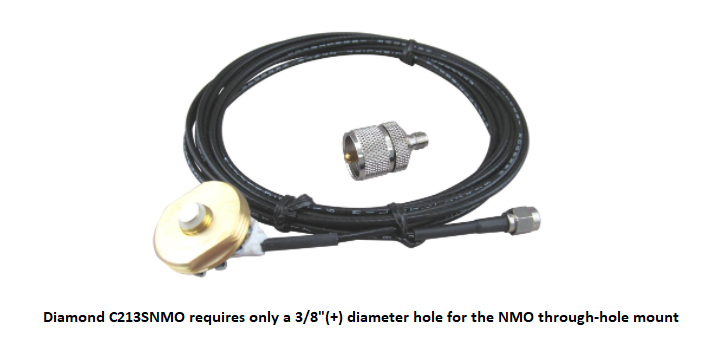
Diamond C213SNMO Mount at DX Engineering
Diamond C213SNMO Mount at Ham Radio Outlet
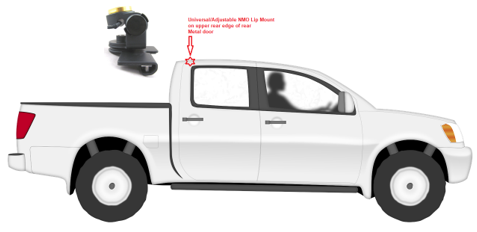
NMO Mobile Antenna Adjustable-Universal Lip Mounts
For SUV, Crossover and Van hatchback door upper corner
Also Pickup Truck upper rear of rear door
COMPACtenna 2M-220-440 W0RS Mobile Installation:
Example of NMO Mobile Antenna Adjustable-Universal Lip Mount
Diamond K412CNMO at DX Engineering
Diamond K412CNMO at Ham Radio Outlet
PICKUP TRUCKS
Magnet mount on corner of pickup truck cab:
Examples of magnet mounts
With these Pulse-Larsen magnet mount types, designed for up to microwave frequencies, leave the center pin/disk and inner dielectric in place:
NMO Magnet Mount at DX Engineering (solder type PL-259)
NMO Magnet Mount at Ham Radio Outlet (crimp type PL-259)
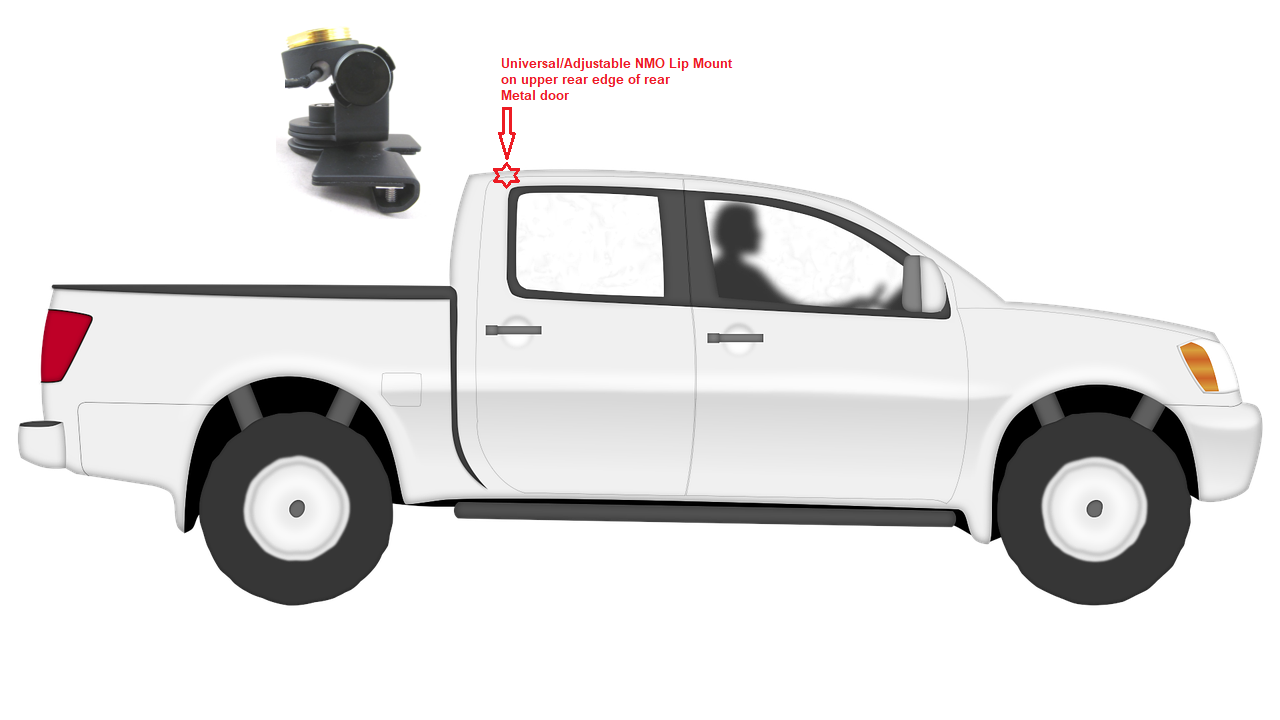
Example of NMO Mobile Antenna Adjustable-Universal Lip Mount
Diamond K412CNMO at DX Engineering
Diamond K412CNMO at Ham Radio Outlet
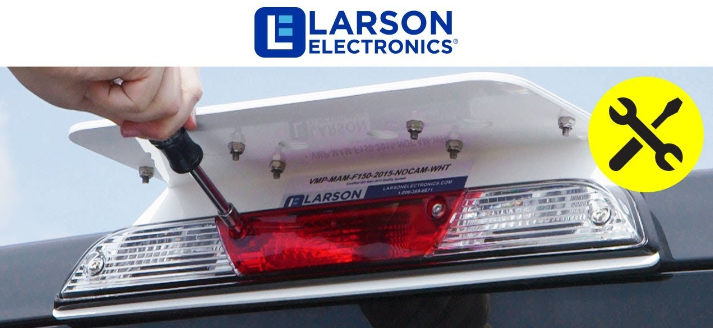
Users report success with installation of COMPACtenna on a plate-style 3rd brake light mount such as from LarsonElectronics.com at a corner of the plate away from the vehicle.
NMO Thru-Hole (Roof Type) Mount
Some NMO Thru-Hole Mounts require a 3/4″ hole, these require only a 3/8″ hole:
Diamond C213SNMO Mount at DX Engineering
Diamond C213SNMO Mount at Ham Radio Outlet
Hustler CHMA-P at Ham Radio Outlet
L-bracket on the upper back corners of the cab of pickup trucks.
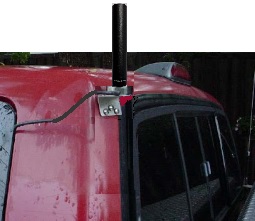
Examples of NMO L-Bracket Mount Assemblies
Larsen L-Bracket (3/4″ NMO hole) at DX Engineering
Larsen NMO Thru-Hole Mount with cable for 3/4″ hole at DX Engineering
7.5″ & 9″ VHF/UHF models
Models: 2M/440 2M/220/440 2M/440PLUS 220MAX LMR-I SCAN-III
Base Station Application
On COMPACtenna CompacCounterpoise Ground Plane Radial Base Station Adapter Kit:

To reduce parasitic interaction, min. recommended height above ground and distance from RF-interacting materials is 10’; performance often escalates substantially 30’ (+) above ground.
– – – – – – – – –
Models: PERFECT CB and PERFECT 10
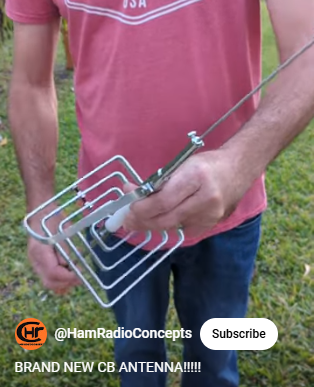
COMPACtenna Antenna Models PERFECT 10 & PERFECT CB are the same,
except that the stinger whips are pre-cut for user convenience
to 44 ½” for the PERFECT CB, 40 ½” for the PERFECT 10.
[Installation notes apply to both models.]
Vehicle application: Mount on vehicle at a sensible location appropriately.
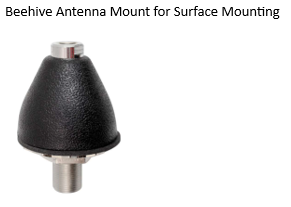
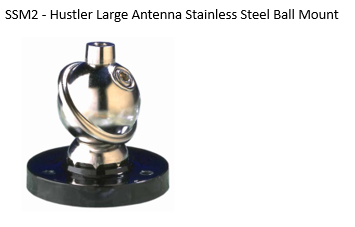
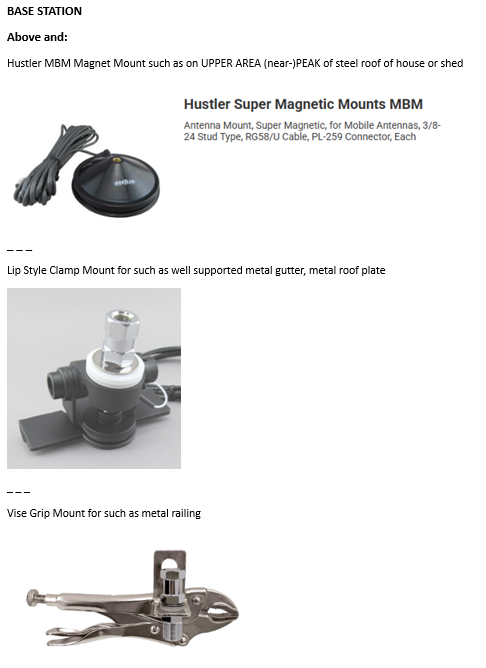
A variety of 3/8”-24 thread sturdy mount types are available on the market. See below.
SWR frequency range varies with vehicle construct, and where on the vehicle the antenna is mounted.
Keep antenna substantially above nearby metal, limit horizontally adjacent near field parasitic interaction.
Base Station application: Mount antenna on a sufficient appropriate ground plane counterpoise.
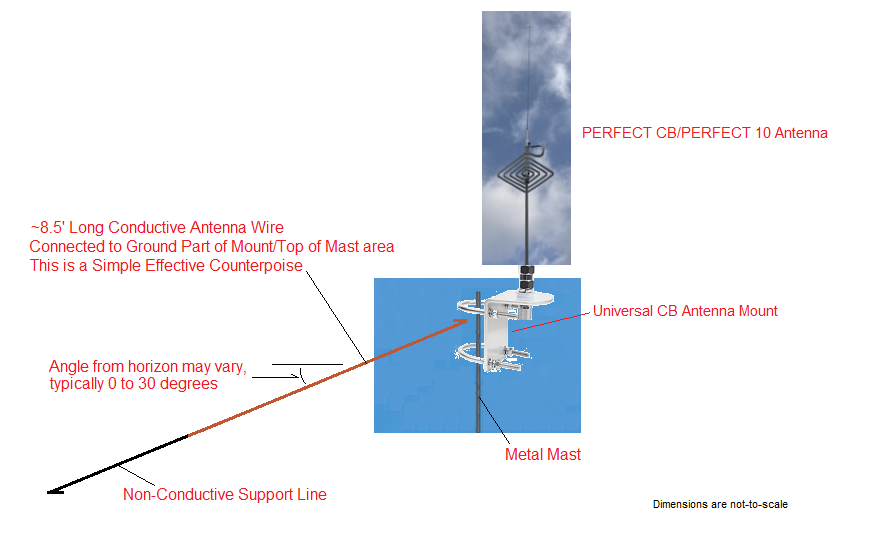
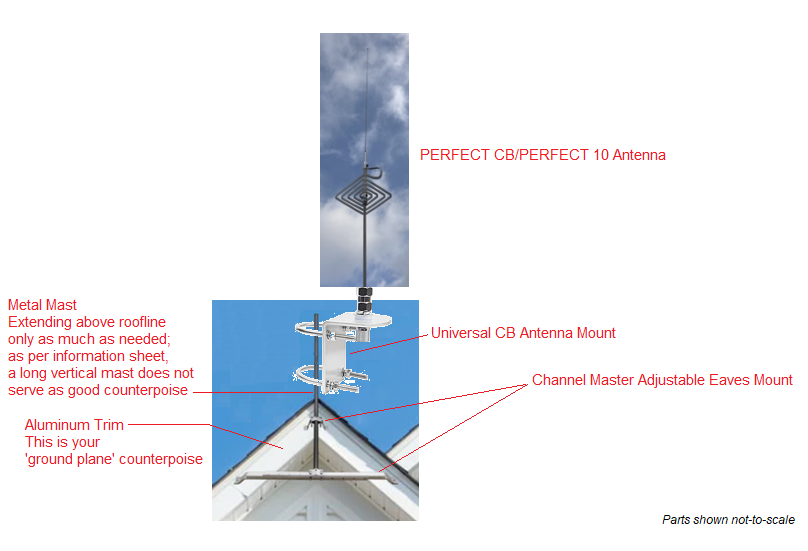
Possible installations include 3/8”-24 thread magnet/clamp/bracket mounts on house/shed/building metal roofs (upper area), well supported metal gutter/trim, a metal railing. A general rule is that expansive [8’(+)] metal in at least one horizontal/angled somewhat downward direction can yield a reasonable SWR. Mounting simply to the top of a vertical metal mast typically does not, although adding an ~8.5 foot long counterpoise wire connected at the top shield/ground side and supported horizontally/at a slight downward angle can serve as a simple effective counterpoise. See below.
Height above ground affects signal pattern, and SWR.
Keep antenna substantially above nearby metal/RF-interactive materials. Limit horizontally adjacent near field parasitic interaction, far field shadowing.
Outside installation is recommended to decrease noise from indoor switching power supplies and other electrical devices.
If creating a hole/holes is/are being considered, temporarily securing the mount (for vehicle application, not moving), or trying a magnet mount (on steel, magnetically secured; on aluminum, supported – capacitive coupling exists with both) or a clamp mount at/near the intended location, may help to give an idea of SWR before the hole(s) is/are made.
Always check SWR; operate only per transmitter specifications.
Tuning can be done by adjusting whip position in Ferrule, or trimming whip.
The frequency shifts ~0.1 MHz with ½” change in length; increase in length lowers freq.; decrease in length raises freq.
Use threadlocker on whip set screws after tuning is completed.
(V)SWR: Nominal < 2:1 [ Often 1.1-1.5:1 ]
Models PERFECT 10 & PERFECT CB are the same, except that the stinger whips are pre-cut for user convenience to 44 ½” for the PERFECT CB, 40 ½” for the PERFECT 10. The accessory ‘PERFECT 10/CB REPLACEMENT WHIP’ is 44 ½” long; trim if/as needed.
Wt. 1.5 lb.
Gain: Nominal 7(+) dB-MEG – Mean Effective Gain in the dynamic obstructed environments
of the world we live in, with COMPACtenna’s ‘PERFECT CB/PERFECT 10’ diverse EM (ElectroMagnetic) fields – phase diversity in same and orthogonal polarizations-elliptical polarization
Maximum Power Ratings – under normal use and conditions
1500 Watts SSB voice; 750 Watts FM-Digital voice; 500 Watts AM voice; 250 Watts Digital Data modes
Each Antenna is quality checked and tuned. Keep antenna and mount contacts – area clean.
Removing, re-attaching antenna(s) repeatedly is not recommended as a general rule;
dedicated vehicle & base station systems are best.
[Design and specifications subject to change without notice.]
Considerations for sturdy mounting
Be prudent, showing care and conscientiousness



Paul from Texas sent a photo of his easy installation and writes:
I simply affixed the L-bracket of a standard mobile CB antenna mirror mount
on the end of my roof gutter with a standard vice grip.
This is the stealthy look and performance that I was looking for.
It’s working great!
SWR’s are 1:1 to 1:4 across 11 meters.
With my antenna mount on the gutter only about 10 feet above the ground,
I am talking with area locals 45+ miles away!
And I’ve been able to do DX as well all over the country.
Thank you!

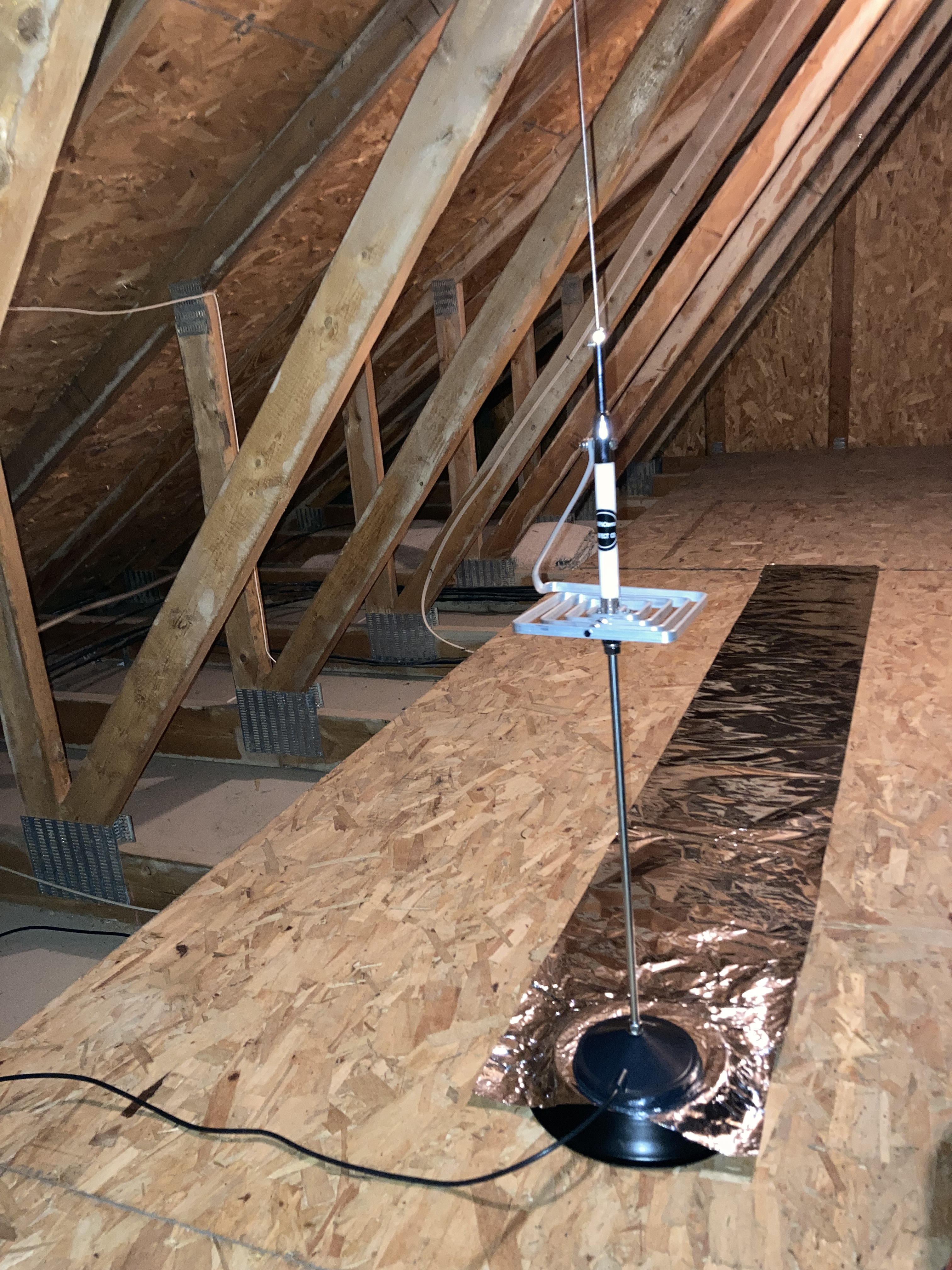
Although outdoor installation is recommended to reduce RF noise from indoor switching power supplies, etc., users report success with installations such as in this photo where about 8′ of standard aluminum foil is at its end sandwiched between a (Hustler brand) magnet mount above and a steel plate/cookie sheet/pan below:
 COMPACtenna